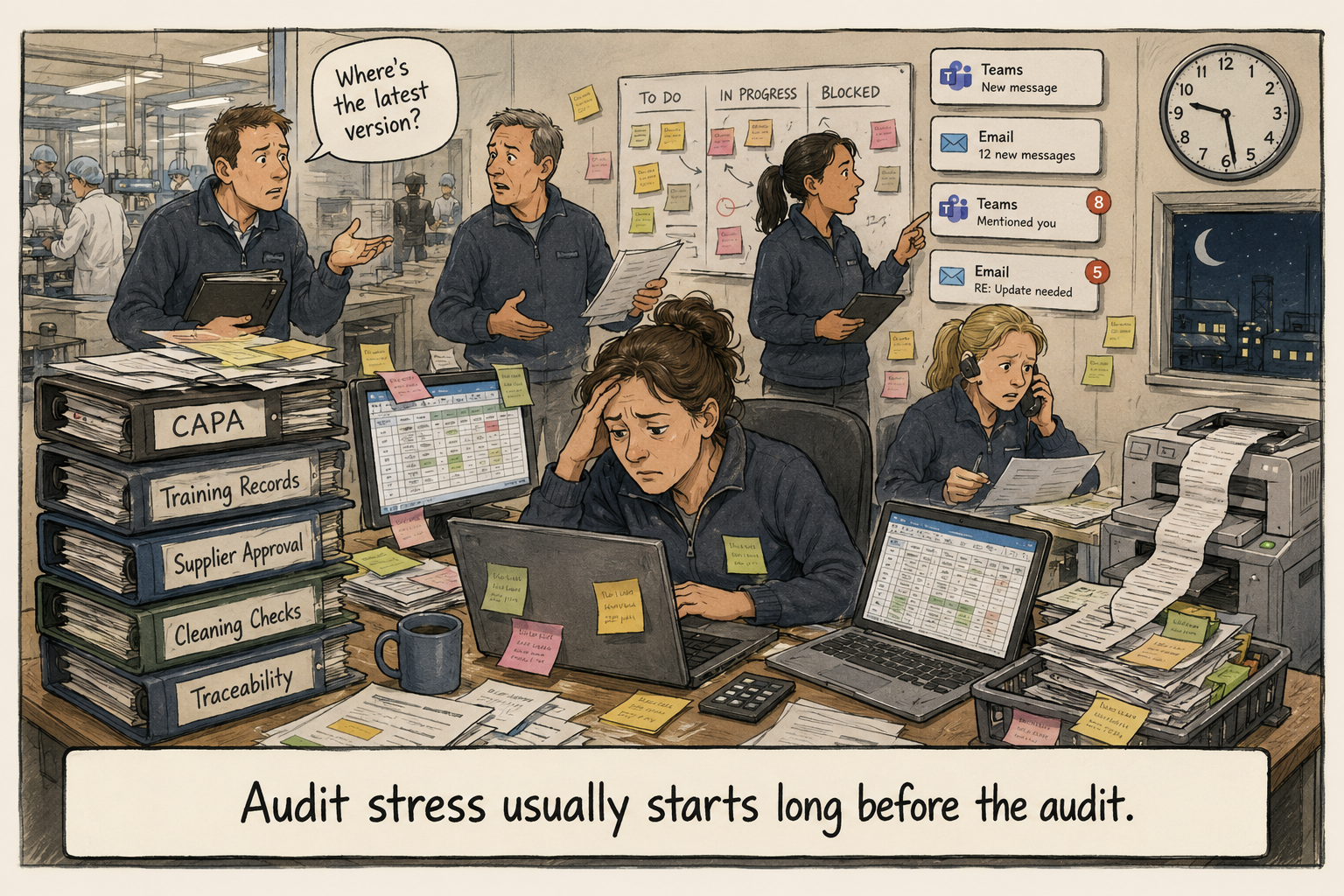
Audit Stress Usually Starts Long Before the Audit
Most businesses describe audits as stressful events.
But in practice, the stress often starts much earlier.
Long before the auditor arrives.
Long before certification reviews are scheduled.
Long before anyone starts preparing evidence folders or chasing records across departments.
What the audit often reveals is operational fragmentation that already existed day to day.
That’s an important distinction.
Because many organisations treat audit pressure as a compliance issue, when it is often a workflow visibility issue instead.
The audit simply exposes where coordination has become difficult.
The Operational Pattern Behind Audit Pressure
In manufacturing and technical environments, the same operational patterns appear repeatedly.
Teams chasing records across inboxes and shared folders.
Different versions of spreadsheets circulating at the same time.
Production teams being interrupted to retrieve information manually.
Managers spending days compiling KPI reports from multiple systems.
People relying on memory because processes are not fully visible.
And somewhere in the business, there is usually one person who “knows where everything is.”
None of this necessarily means the business is poorly run.
In fact, many of these businesses have highly capable teams and experienced operators.
The issue is rarely effort.
The issue is coordination.
Over time, small workflow gaps quietly accumulate operational friction.
A missing ownership step here.
A manual handover there.
A report that requires data from four different places.
An approval process that only works when a specific person is available.
Individually, these problems seem manageable.
Collectively, they create operational fatigue.
Audits Often Expose Existing Visibility Problems
One of the reasons audits feel disruptive is because they force businesses to reconstruct operational visibility reactively.
Information that should already be accessible suddenly becomes urgent.
Evidence gathering becomes a project in itself.
Teams stop focusing on forward operational work and start searching backwards for proof, records, approvals, and traceability.
That pressure is rarely caused by the audit alone.
It is usually the accumulated result of workflows that are difficult to see clearly during normal operations.
This is why some businesses experience audit preparation as a recurring fire drill.
Not because they lack good people.
Because too much operational coordination depends on manual effort.
Hidden Labour Cost Builds Quietly
A lot of operational admin burden becomes normalised over time.
Especially in growing SMEs.
People adapt around inefficient workflows because the business is busy and production priorities naturally come first.
So teams create workarounds.
Extra spreadsheets.
Manual trackers.
Personal reminders.
Duplicated reports.
Folder structures that only make sense internally.
Eventually, the business becomes dependent on individuals rather than operational structure.
The problem is that hidden coordination labour scales badly.
As order volumes increase, customer requirements become more complex, or reporting expectations grow, the admin pressure expands with it.
At that point, audit preparation stops feeling occasional.
It starts feeling constant.
The Businesses That Handle Audits Calmly Usually Share Similar Traits
Interestingly, the organisations that manage audits with less stress do not always have the most advanced systems.
Often, they simply have clearer operational workflows.
Ownership is easier to follow.
Information is easier to retrieve.
Reporting is more consistent.
Teams are not relying on memory to bridge process gaps.
Coordination happens continuously rather than reactively.
In these environments, audits become less disruptive because the operation itself is already visible.
The workflow supports the evidence naturally.
That operational calmness is usually built gradually.
Not through heroic preparation weeks before an audit.
And not through adding more software indiscriminately.
Simplification Matters Before Automation
One common mistake businesses make is trying to automate fragmented processes before simplifying them.
But automation rarely solves operational confusion on its own.
If ownership is unclear, reporting is inconsistent, or workflows depend heavily on manual interpretation, adding more tools can simply increase complexity.
Strong operational improvement usually starts with visibility.
Understanding:
- where information originates
- how work moves through the business
- where duplication occurs
- where delays are introduced
- which processes depend heavily on individuals
- which reports require excessive manual handling
Only then does automation become genuinely useful.
At that stage, automation acts as a support layer.
Not a substitute for operational structure.
Workflow Clarity Reduces More Than Audit Stress
What is often overlooked is that improving workflow visibility benefits far more than compliance activity.
It reduces interruptions.
It lowers dependency risk.
It improves reporting consistency.
It reduces time spent chasing information.
It creates operational stability as businesses grow.
And importantly, it reduces the reactive management behaviour that many teams quietly accept as normal.
That is usually the bigger operational gain.
The audit simply becomes one visible outcome of a calmer operation.
A More Useful Way to View Audit Pressure
In many SMEs, audit stress is treated as unavoidable.
Just part of the job.
But operationally, it is often a signal worth paying attention to.
Because recurring audit pressure can reveal where workflows are difficult to coordinate, difficult to retrieve information from, or too dependent on individual effort.
Most businesses already have capable people.
Most already have usable systems.
The challenge is usually making workflows more visible, more coordinated, and easier to operate consistently.
That improvement does not normally happen overnight.
But businesses that steadily simplify and clarify operations tend to experience something noticeable over time:
Less scrambling.
Less hidden admin burden.
Less reactive firefighting.
And far less operational stress when audit season arrives.