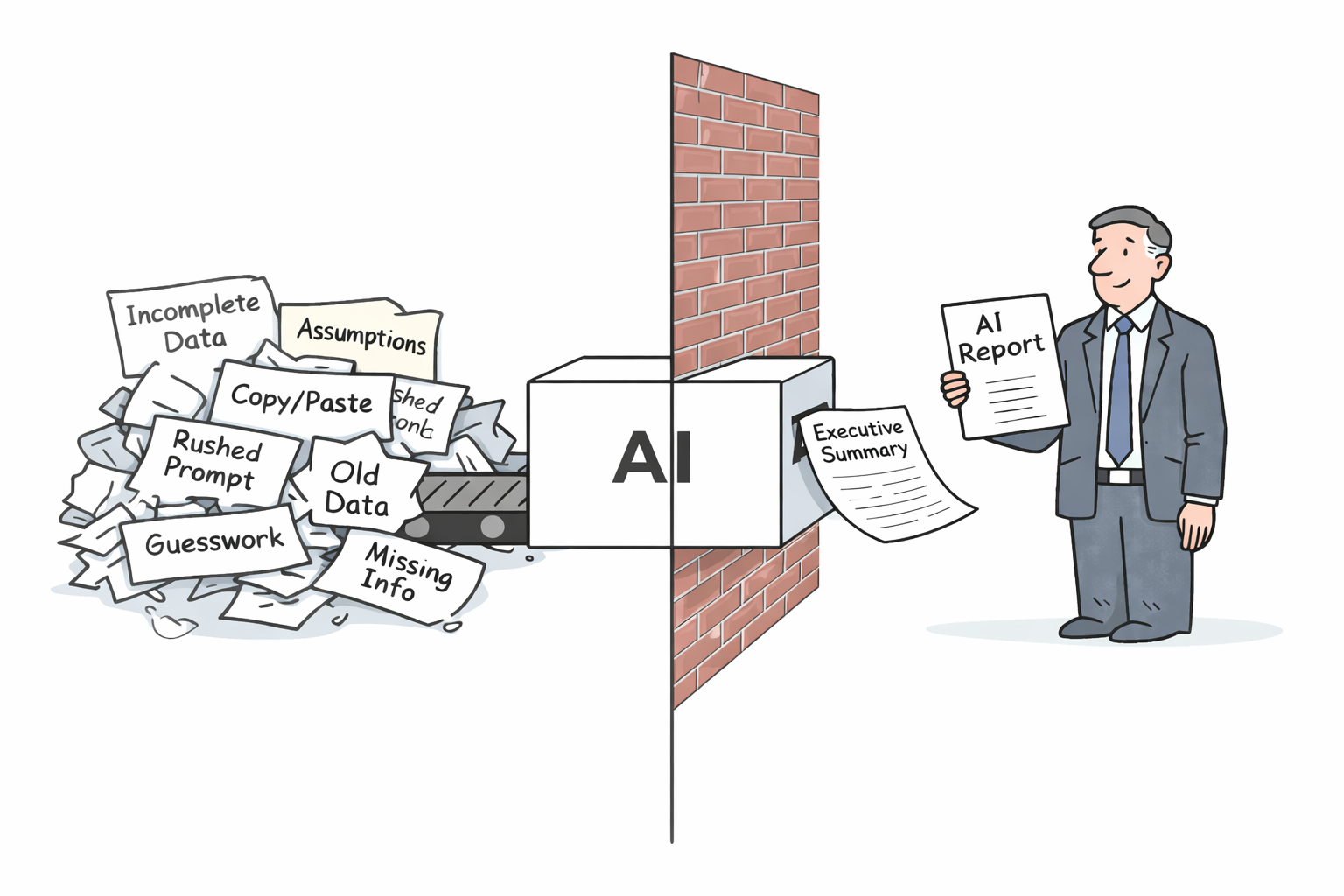
Can AI be trusted?
There’s a simple idea from the 1950s: garbage in, garbage out.
We’ve known for decades that any computer system is only as good as the inputs provided to it.
What’s changed isn’t the rule — it’s the visibility.
With models trained on vast amounts of internet data, we no longer have clear sight of what’s going in. Couple that with poorly structured prompts, and while a polished report is produced, the question becomes:
Can you trust the findings?
We’re already seeing the impact in real-world cases.
A Deloitte report prepared for the Australian government had to be corrected — and partially refunded — after it was found to include AI-generated content with fabricated references and errors.
https://www.theguardian.com/australia-news/2025/oct/06/deloitte-to-pay-money-back-to-albanese-government-after-using-ai-in-440000-report
In the legal system, there have been multiple cases of lawyers submitting AI-generated case law that didn’t exist, resulting in sanctions and fines.
https://www.bbc.com/news/world-us-canada-65735769
These aren’t extreme cases — they’re just the ones large enough to be visible.
So how many other business-critical decisions are being made based on flawed outputs?
This is compounded by the speed at which AI delivers results — quickly, confidently, and with a level of polish that makes them easy to accept at face value.
Some businesses are getting real value from AI. Others are adding complexity and wondering why things feel harder, more rushed, and more opaque.
The difference isn’t the tools.
It’s whether the inputs and the workflows are clear to begin with.
When they are, AI accelerates operations and reduces admin, delivering measurable results.
When they aren’t, AI simply amplifies the problems.
There’s no question that AI has the potential to be a force multiplier in business, delivering extraordinary value.
But unless it’s built on well-defined workflows and reliable inputs, you’re not removing chaos — you’re scaling it.
Faster outputs.
More confidence.
Same underlying problems.
AI doesn’t remove the need for thinking.
It makes it more important.