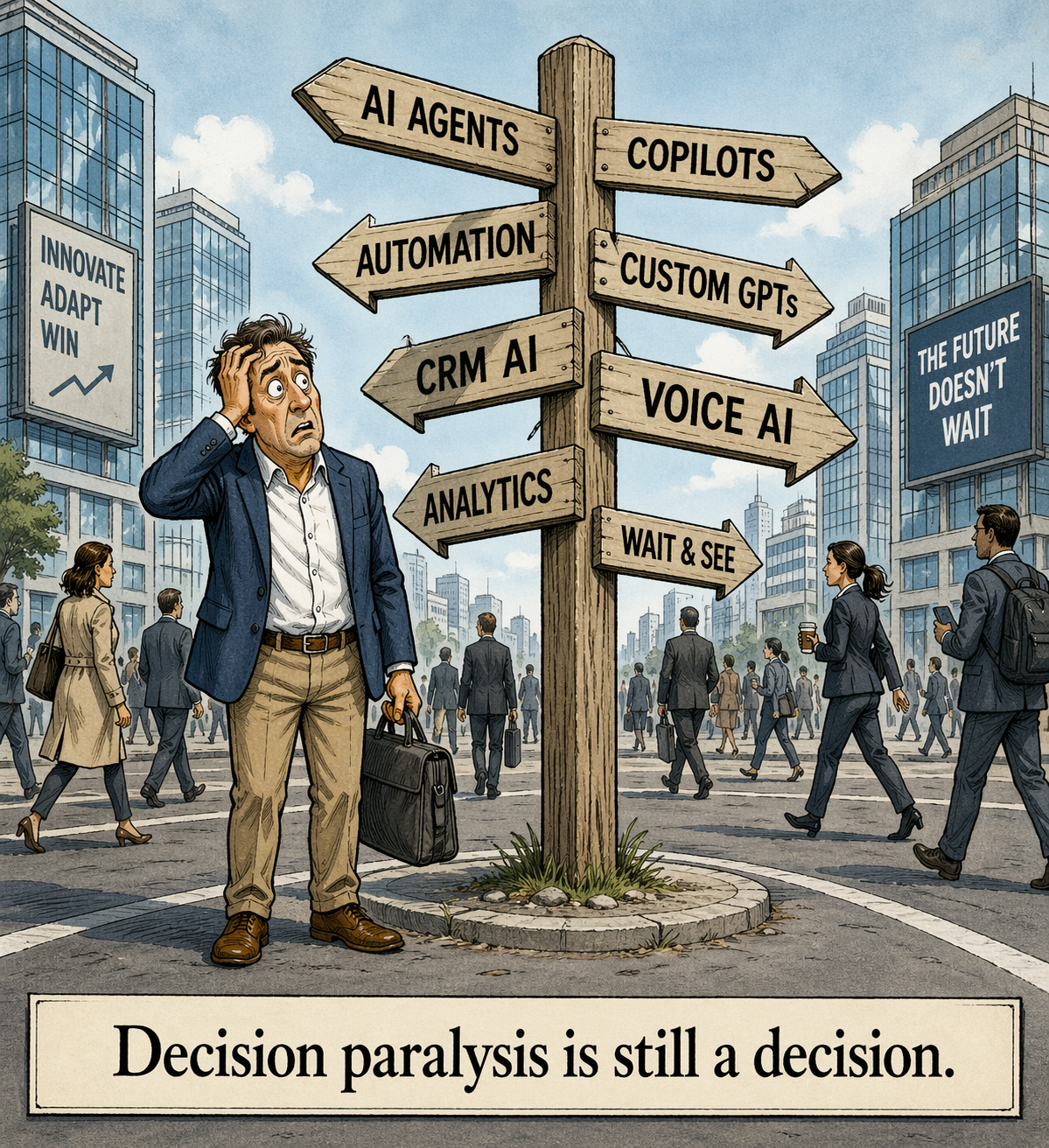
Decision paralysis is still a decision
A lot of business owners know they should be looking seriously at AI, automation, or simply better ways of working. They can see the headlines, they hear the conversations, and they know something is changing.
But many are still standing at the crossroads waiting for the perfect route to reveal itself.
The problem is, the perfect AI choice doesn’t exist.
Every week there seems to be a new tool, a new platform, a new promise, or a new expert telling you that if you don’t move immediately, you’ll be left behind. For many SMEs, what should feel like opportunity has started to feel more like noise.
And when people are presented with too many options, especially expensive or important ones, they often do what most sensible people do.
- They pause.
- They hold off.
- They wait for the market to settle.
- They tell themselves they’ll come back to it when they have more time.
That is completely understandable. It is also where many businesses get stuck. This is a perennial problem in business repeated over the years.
- Websites.
- e-commerce.
- CRMs.
- Cloud systems.
- Dashboards.
Now it’s AI.
Each time, many businesses assumed they needed to make one big, perfect decision. One move that would future-proof everything and solve all the problems in one go. That usually isn’t how progress happens.
In reality, the businesses that tend to move forward are rarely the ones making grand declarations. They are normally the ones steadily improving what matters and being honest enough to cut what doesn’t. Too many businesses carry tasks, reports and routines that serve no clear purpose. Removing noise is often where momentum starts. The same applies now.
Most SMEs do not need a sweeping AI transformation strategy. They need to fix the handful of recurring frustrations that waste time, money and energy every week.
That could be quotes taking too long to turn around, staff retyping information from one system into another, customer enquiries sitting too long without follow-up, reports taking half a day to produce. Important files being difficult to locate. Too much key knowledge sitting with one person.
That is where the real opportunity usually sits, not in chasing the latest shiny tool because it’s trending this week.
One of the most common mistakes is starting with the question:
“What AI system should we buy?”
Usually that is the wrong starting point. A far better place to begin is with a few honest questions about the business itself.
- Where are we repeatedly wasting time?
- What causes frustration for staff?
- What creates avoidable errors?
- What slows customers down?
- What admin work adds little value but consumes hours?
- What depends too heavily on one individual?
Once you understand those answers properly, the right tools become much easier to identify.
Technology should follow the problem, not the other way round.
Too many businesses are trying to buy a solution before they have clearly defined the issue. It is a bit like shopping for a forklift before deciding whether you even need a warehouse.
Meanwhile, the companies making genuine progress are often doing something much less dramatic.
- They are improving one process at a time.
- They are removing one bottleneck.
- They are automating one repetitive task.
- They are giving staff back small amounts of time that add up over the course of a month.
- They are creating momentum.
That may not be as exciting as announcing a company-wide AI strategy, but it is usually far more valuable.
Small gains compound.
- A few hours saved each week.
- Faster response times.
- Fewer mistakes.
- Better visibility.
- Less frustration.
- Stronger consistency.
Those are real business outcomes.
So if AI currently feels like a confusing crossroads, my advice would be to remove the pressure.
- You do not need the perfect plan.
- You do not need to transform everything in one move.
- You do not need to become a technology company overnight.
You just need to identify one genuine pain point and improve it, then do the next one and then the one after that.
That is how most successful change actually happens. The businesses that benefit most from AI over the next few years probably won’t be the loudest ones talking about it today.
They’ll be the ones quietly becoming easier to run, month by month.
So if you’re waiting for the perfect route to appear, it may be worth remembering:
It usually doesn’t.
But useful first steps do.