The Real Lesson from the Palantir NHS Debate
A recent article defending Palantir's NHS contract focused heavily on politics, sovereignty and supplier dependency. Those are important discussions, but I think they risk distracting from the more interesting lesson.
The real story isn't about Palantir.
It's about operational friction.
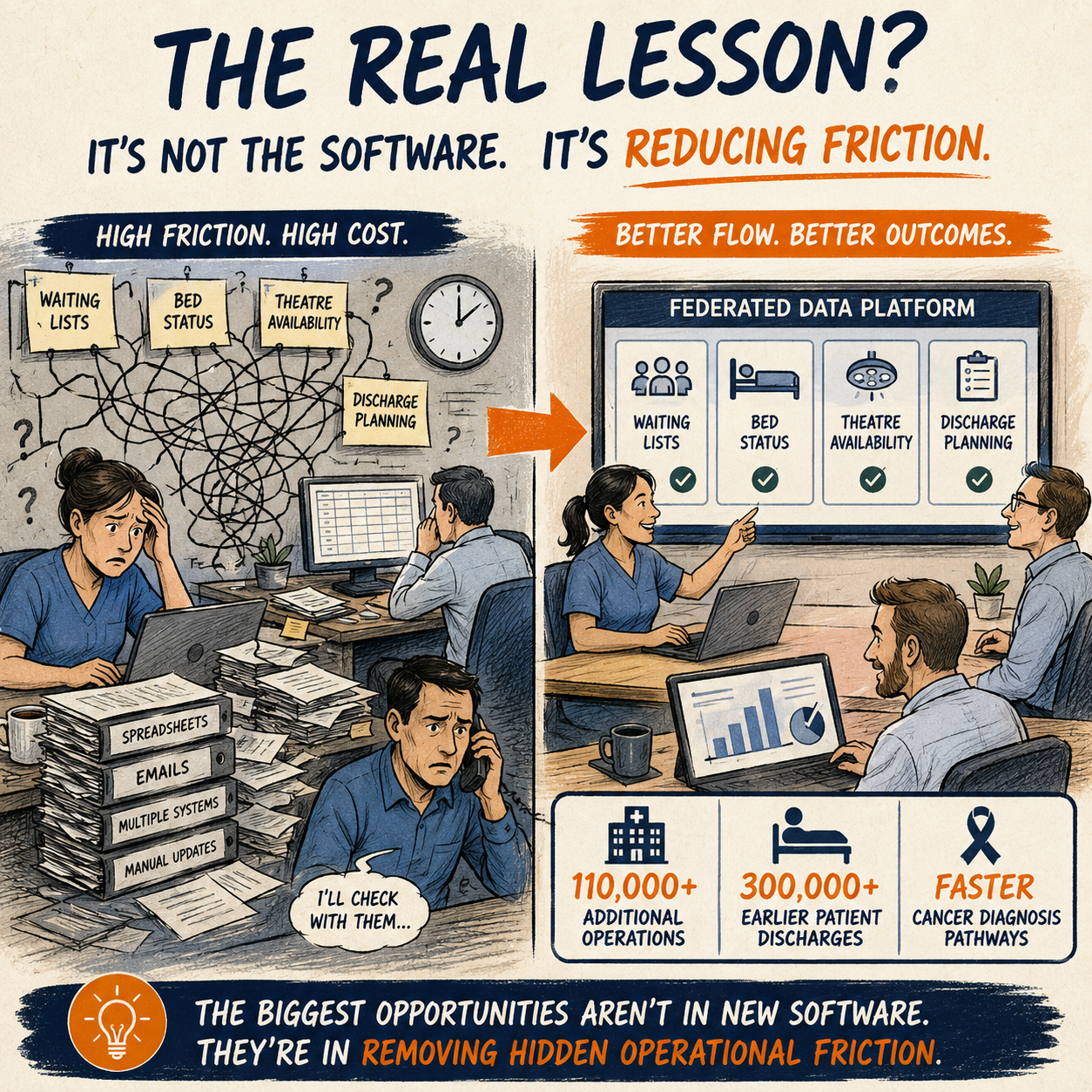
According to NHS figures quoted in the article, the Federated Data Platform has contributed to:
- More than 110,000 additional operations
- Nearly 300,000 earlier patient discharges
- Faster cancer diagnosis pathways
Whether you support or oppose the supplier involved, those outcomes raise an important question:
How were those benefits actually achieved?
Many people assume digital transformation is primarily about software. It isn't.
The software is the tool.
The value comes from connecting information that was previously fragmented across multiple systems, teams and processes.
A hospital already knows:
- Which patients are waiting
- Which beds are occupied
- Which operating theatres are available
- Which clinicians are scheduled
The challenge is that this information often exists in different places, owned by different teams, using different systems.
When information is disconnected, delays occur.
Operating theatres sit unused because one team doesn't have visibility of another team's constraints.
Patients remain in hospital because discharge planning isn't coordinated.
Clinicians spend time searching for information rather than acting on it.
The software didn't create new hospitals, new doctors or new beds.
It reduced friction.
And that's a lesson that applies far beyond the NHS.
Many SMEs are facing exactly the same challenge.
Sales know one thing.
Operations know another.
Finance has different information again.
Critical data lives in spreadsheets, emails, individual inboxes and people's heads.
The result is hidden operational friction:
- Delayed quotations
- Delayed decisions
- Rework
- Duplicate data entry
- Missed opportunities
- Key-person dependency
Businesses often look for a software solution first.
But the software is rarely the starting point.
The starting point is understanding how work actually flows through the organisation.
Where does information originate?
Who needs it next?
Where does it stop?
Where is it manually copied?
Where does someone wait for approval?
Where does the process depend on a single individual?
Only once those questions are answered does technology become truly effective.
The NHS example is interesting because it demonstrates what can happen when information flows more effectively between teams.
The same principle applies whether you are managing patient pathways, manufacturing products, processing customer orders or running a professional services business.
Technology matters.
But workflow matters more.
The greatest opportunities for improvement are often not found in buying new software.
They are found in identifying and removing the hidden operational friction that slows everything else down.